


Project name: Status assessment of the large copper butterfly (Lycaena dispar) in the Natura 2000 area ‘Livade uz Bednju III’
Client: Hrvatske ceste d.o.o.
Period: 4/2025 – 5/2025
Location: Croatia
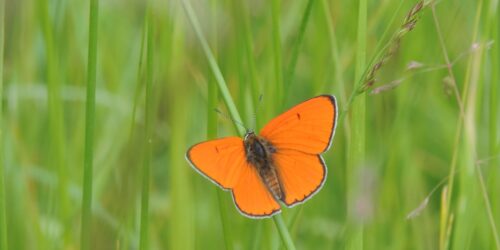
The company Hrvatske ceste d.o.o. has contracted the company Oikon d.o.o. to carry out works aimed at determining the status of the large copper butterfly (Lycaena dispar (Haworth, 1803)) in the area of the Natura 2000 ecological network site HR2001410 “Livade uz Bednju III”, in accordance with legally prescribed environmental protection measures and mitigation measures regarding impacts on conservation objectives and the integrity of the ecological network area, and their implementation (A), as well as the implementation of the environmental and ecological network monitoring programme (B). The measures are prescribed by the Decision of the Ministry of Environmental Protection and Green Transition (formerly the Ministry of Environmental and Nature Protection) for the project of the eastern bypass of Novi Marof (CLASS: UP/I 351-03/14-02/71, REG. NO: 517-06-2-1-2-14-8 of 14 October 2014).
A final report on the field research of the target butterfly species for the year 2025 was produced, presenting the initial (baseline) results, as no previous research of this species has been carried out in the context of the eastern bypass of Novi Marof. The document serves as a key basis for understanding the population status and for the effective implementation of the prescribed protection measures.
In accordance with the prescribed Environmental and Ecological Network Monitoring Programme with an implementation plan, field research was conducted to assess the status of the large copper butterfly population.
The research area covered the project impact zone within the ecological network, with an emphasis on wet grasslands, stream banks, canal edges, and shrublands, wherever accessible. The research was conducted between 10:00 and 16:00, at temperatures above 17 °C, under weather conditions suitable for butterfly activity. The methodology applied was transect line counts, which is the simplest and most effective method for observing long-term changes in butterfly abundance. A transect is a fixed route that runs along or diagonally across the site, typically 5 m wide, within parts of the habitat where butterflies are present. It is also divided into sections representing homogeneous habitats or management conditions. Two researchers simultaneously surveyed the area, moving with minimal distance between them to ensure full coverage and minimise observation overlap. GPS devices were used to record geographic coordinates (points) of the species’ locations. To confirm identification, butterflies must be photographed, specifically the underside of the hindwing, particularly for females.
The following was recorded at each observation point:
- Observers of the target butterfly species
- Original GPS location ID
- Date and time of the target species observation, in the format e.g. 2025/05/20 10:13:51
- Latin name of the target butterfly species
- Sex of the observed individual (male or female)
- Number of individuals of the target butterfly species
- X and Y coordinates in the HTRS/96 coordinate system
The presence of the target species was confirmed at a total of eight locations, with no females observed. At the remaining surveyed locations, the species was not recorded. Limiting factors identified included pressures related to agricultural production and land improvement interventions along watercourses. It is important to note that while the abandonment of agricultural production may initially have a positive impact on the species’ spread, it can pose a long-term threat to population survival, especially if it leads to habitat succession and overgrowth with unsuitable vegetation.
Implementation of this Project contributes to the following Sustainable Development Goals:
