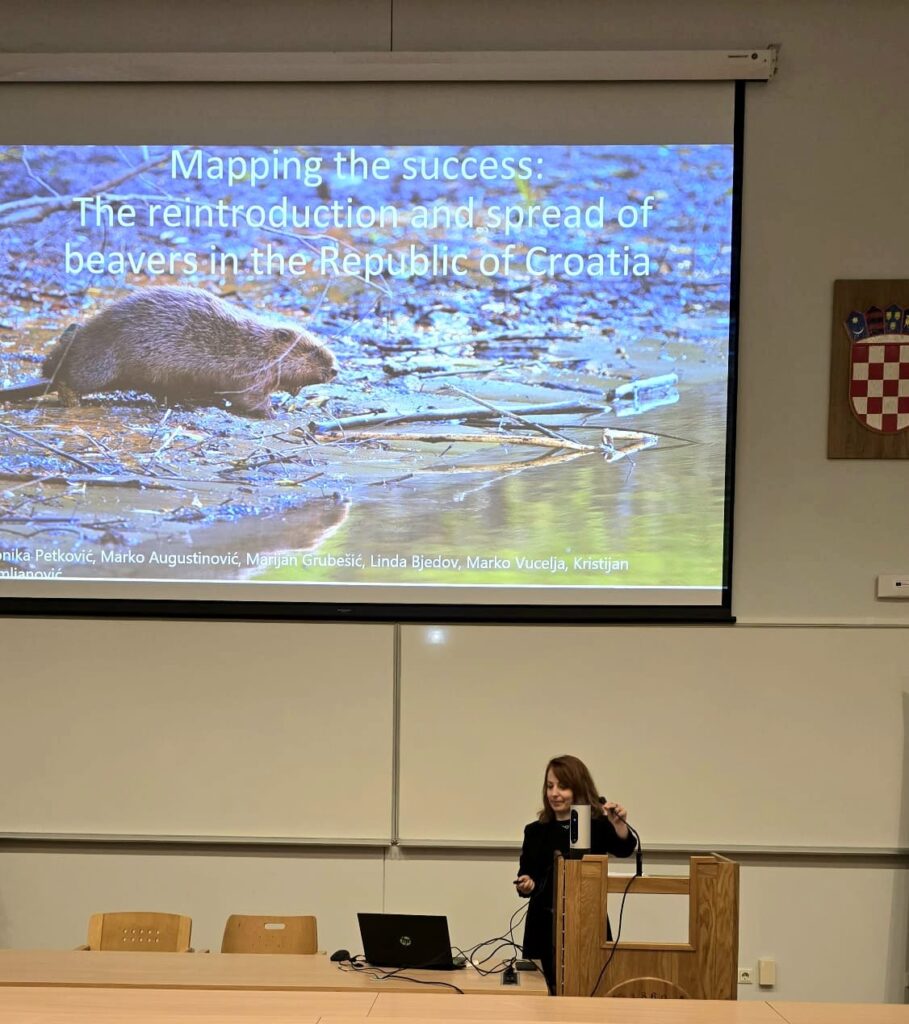
April 27, 2026 – Oikon’s experts, Monika Petković and Marko Augustinović, participated in the international conference “Eurasian beaver in the Danube region”, organised by the Faculty of Forestry and Wood Technology at the University of Zagreb.
The conference brought together researchers and practitioners focused on the conservation and management of the Eurasian beaver across the Danube region, with an emphasis on monitoring population expansion and density, as well as coexistence with humans.
Monika Petković presented Oikon’s work in a talk titled “Mapping the success: The reintroduction and spread of beavers in the Republic of Croatia.” She explained how the beaver, once extinct in Croatia due to overexploitation in the 19th century, was successfully reintroduced between 1996 and 1998 through the project “Dabar u Hrvatskoj” (eng. Beaver in Croatia). Individuals from Bavaria were released near Žutica in the Sava River basin and Legrad in the Drava River basin. Population spread was monitored as a part of a reintroduction project, and since 2019, additional projects on semiaquatic mammals have expanded the dataset. Now the entire data has been consolidated and analysed across time intervals, providing a clear picture of beaver distribution in Croatia.
Today, the beaver occupies most of the Black Sea basin in Croatia, with its southernmost range at the source of the Una River near Suvaja. It is widespread in continental and alpine biogeographic regions, while still absent from the Mediterranean region. According to the latest data, the species is present in 322 grid cells (10 × 10 km) of the national HTRS network, covering 27,152 km². Of this, 26,085 km² lies in the continental region and 1,067 km² in the alpine region.
The recovery of the Eurasian beaver in Croatia is a clear example of effective species reintroduction, long-term monitoring and data integration. It also shows the value of combining expert work and stakeholder engagement with citizen-reported observations. Oikon continues to support biodiversity research and provide expert input for sustainable environmental management across the region.