


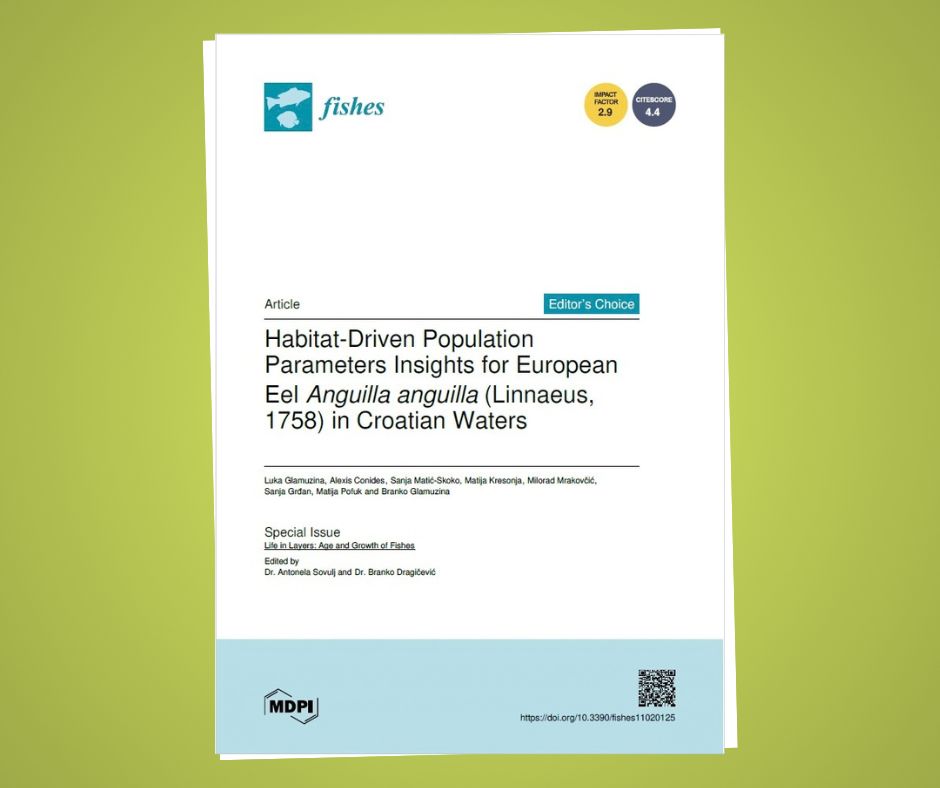
October 9, 2026 – European eels (Anguilla anguilla) in the rivers and brackish waters of the Croatian coast are under heavy fishing pressure. The authors of a new study recommend raising the minimum landing size from 35 cm to at least 45 cm. The paper, “Habitat-Driven Population Parameters Insights for European Eel Anguilla anguilla (Linnaeus, 1758) in Croatian Waters”, was published in Fishes (MDPI). Two of its authors are from Oikon: Matija Kresonja and Prof. Milorad Mrakovčić.
Until now, little had been published on eels in the Eastern Adriatic, especially on how river and brackish populations differ. The results can serve as a basis for an eel management plan in Croatia and for future conservation measures.
Sampling at 23 sites
The data come from the project Monitoring of Eel in Inland Waters under the National Plan for Data Collection in Fisheries of the Republic of Croatia. From September 2023 to July 2024, eels were sampled every season at 23 sites along the coast. The sites included the Mirna, Raša, Zrmanja, Krka, Cetina and Neretva rivers, smaller rivers such as the Dragonja, Jadro, Žrnovnica and Ombla, Lake Vrana and Lake Prokljan, and the Parila and Ston lagoons. In total, 678 eels were analysed. Oikon’s experts took part in the fieldwork and edited the paper.
What the results show
Freshwater and brackish subpopulations differ. In rivers, most eels had not yet developed a sex (42.8%), while females made up the largest share at brackish sites (46.3%). The oldest freshwater eel was 13 years old and the oldest brackish eel 8, but most eels in both habitats were three to five years old. Freshwater eels were in better condition and grew more slowly, reaching a slightly greater maximum length.
The exploitation rate is close to 80% in both habitats, and more than half of three-year-old eels are already exposed to fishing. A yield-per-recruit analysis shows that catching larger eels would increase yields and make the population more resilient. If the stock does not improve within three to five years, the authors say a full moratorium on eel fishing in Croatia may be needed.
The European eel is listed as Critically Endangered on the IUCN Red List. In the 1930s, Croatia caught about 100 tonnes of eel a year. Over the last decade, reported commercial catches, mostly from the Neretva estuary, have been under one tonne a year. Croatia banned recreational eel fishing in September 2023.
The paper is the result of a collaboration between Oikon, the University of Dubrovnik, the Institute of Oceanography and Fisheries in Split, the Hellenic Centre for Marine Research and the Directorate of Fisheries of the Croatian Ministry of Agriculture, Forestry and Fisheries. We thank our co-authors and the local fishers who helped collect the samples.
Fishes is indexed in Web of Science (SCIE) and ranked Q1 in Marine & Freshwater Biology, and the editors selected the paper as an Editor’s Choice article.
Congratulations to our colleagues Matija Kresonja and Prof. Milorad Mrakovčić on the paper.
Read the open-access paper: Link
