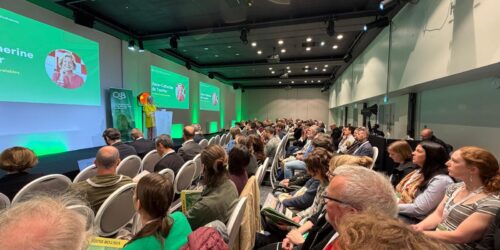
October 30, 2026 – Oikon took part in the first Conference on Solar Energy and Biodiversity (CSB 2026), held in Paris on 28 and 29 October, as part of the EcoSymbia group. The conference aims to develop science-based solutions so that biodiversity is better integrated into solar energy projects. It was organised by France renouvelables, the French professional federation for renewable energy, and brought together scientists, industry representatives and policymakers from around the world.
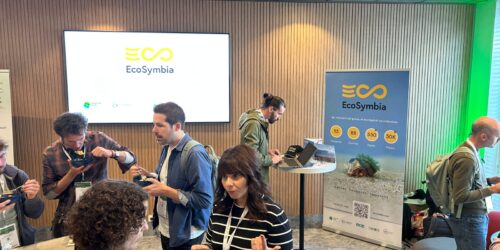
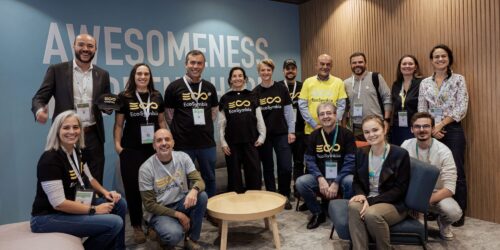
The conference was also EcoSymbia’s first public appearance under its new name. EcoSymbia, formerly known as the European Renewable Energy Wildlife Consortium (ERWC), is a group of five ecological consultancies: Oikon (Croatia), Waardenburg Ecology (the Netherlands), Écosphère (France), NCC (Greece) and Bioinsight (Portugal). Experts from EcoSymbia companies gave seven talks and presented several posters and Écosphère’s poster won third place in the Best Posters Awards.
Oikon and EcoSymbia talks
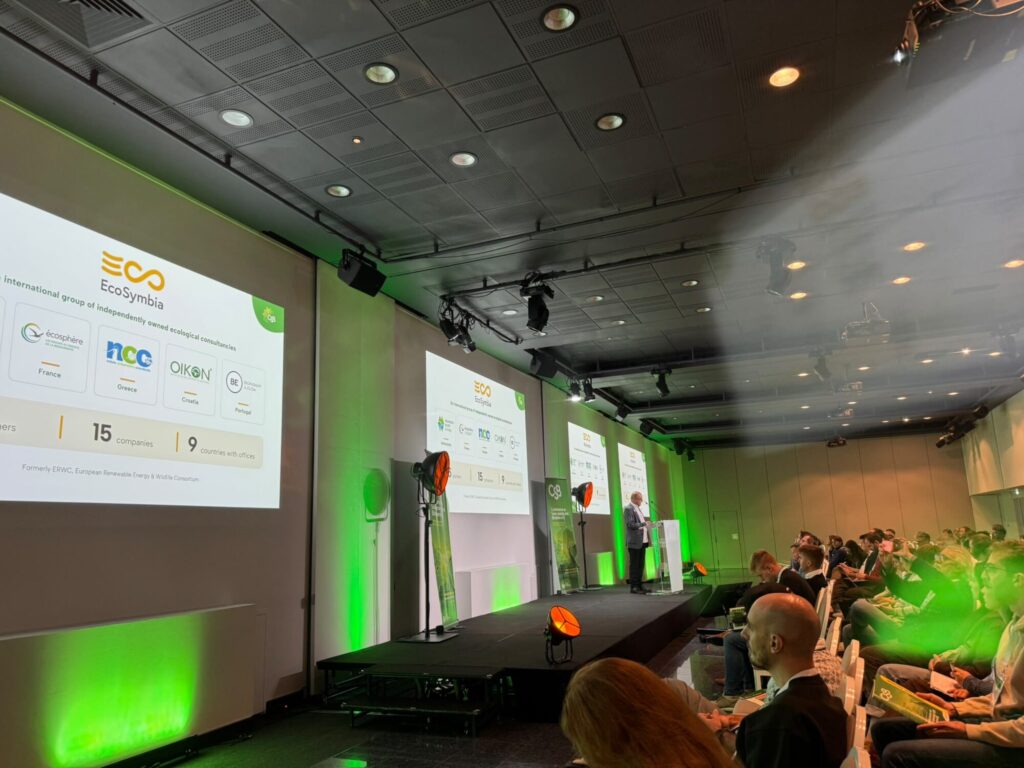
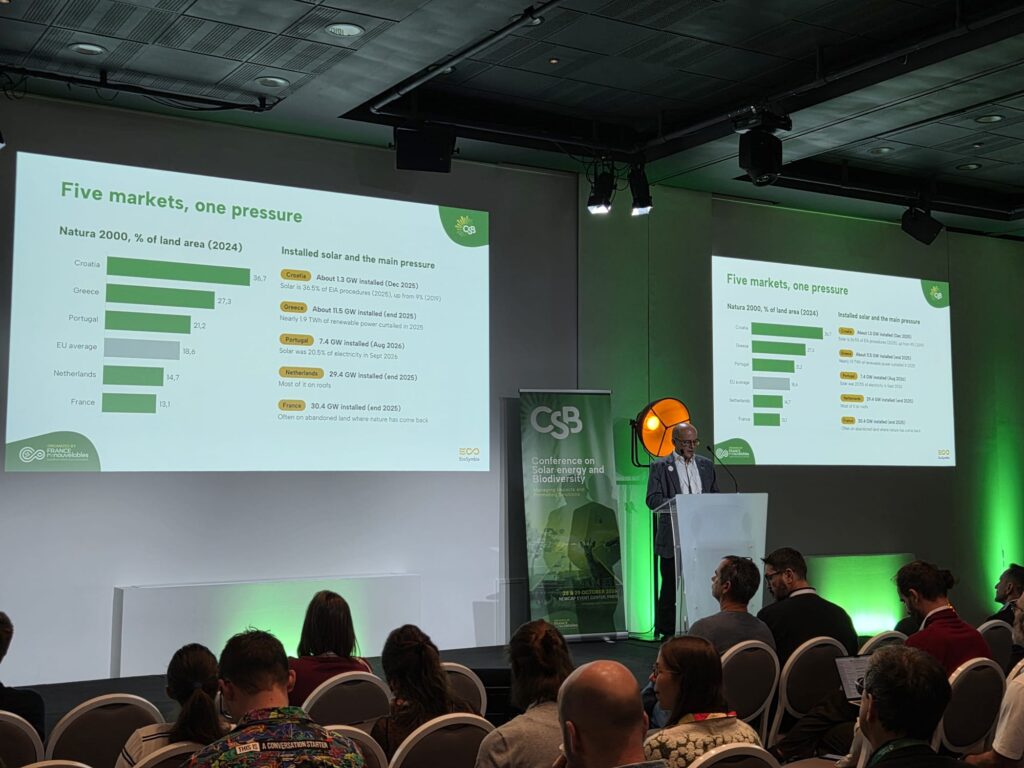
Oikon Director Dalibor Hatić presented EcoSymbia in his talk “One Platform, a Growing Network: Ecological Expertise Behind Europe’s Solar Energy Transition”. Drawing on the partners’ experience, he compared solar development in Croatia, France, Greece, the Netherlands and Portugal. All five are EU countries with the same rules, but their natural conditions are very different. He showed that habitat loss is a bigger problem than wildlife collisions in every country, and that grid connections push projects towards protected areas. The example of the Končanica fishponds, a Natura 2000 site that is drying out, showed how the same impact can be valued in opposite ways. Reduced water evaporation is usually assessed as a side effect of floating solar, but at Končanica it is the reason for the proposed project. The talk concluded that impacts are local, but the methods used to study them can be transferred from one country to another. Projects should be designed to deliver a net gain for nature over their whole lifetime, and that gain should be monitored for 10 to 15 years.
Another Croatian company, Supernatural, an associate member of EcoSymbia, also took part. Its director, Mirna Mazija, gave the talk “Solar Development and Bats: Coordinated Action under EUROBATS (UNEP’s European Bat Agreement)”.
Key messages from the conference
Key messages we took home from the conference:
- Land use is the main driver of biodiversity loss, so where solar parks are built matters.
- Solutions that work for both solar energy and biodiversity are possible, but the mitigation hierarchy must be applied in full: impacts are avoided first, then minimised and restored, and only as a last resort compensated.
- Adaptive management, Biodiversity Action Plans and long-term monitoring are also needed.
We congratulate all EcoSymbia partners on their participation and excellent presentations at the conference.